Apache2 : Configure mod_perl2023/07/19 |
|
Install [mod_perl] to make Perl scripts be fast. |
|
| [1] | Install [mod_perl]. |
|
root@www:~# apt -y install libapache2-mod-perl2
|
| [2] | Configure [PerlRun] mode which always put Perl interpreter on RAM. |
|
root@www:~#
vi /etc/apache2/conf-available/mod_perl.conf # create new # for example, set PerlRun mode under the "/var/www/perl"
PerlSwitches -w
PerlSwitches -T

Alias /perl /var/www/perl
<Directory /var/www/perl>
    AddHandler perl-script .cgi .pl
    PerlResponseHandler ModPerl::PerlRun
    PerlOptions +ParseHeaders
    Options +ExecCGI
</Directory>

<Location /perl-status>
    SetHandler perl-script
    PerlResponseHandler Apache2::Status
    Require ip 127.0.0.1 10.0.0.0/24
</Location>
a2enconf mod_perl Enabling conf mod_perl. To activate the new configuration, you need to run: systemctl reload apache2root@www:~# a2enmod cgid Enabling module cgid. To activate the new configuration, you need to run: systemctl restart apache2root@www:~# systemctl restart apache2
|
| [3] | Create a test Script to make sure the settings are no problem. It's OK if the result like follows is displayed. |
#!/usr/bin/perl

use strict;
use warnings;

print "Content-type: text/html\n\n";

my $a = 0;
&number();

sub number {
    $a++;
    print "number \$a = $a \n";
}
chmod 705 /var/www/perl/test-mod_perl.cgi root@www:~# curl localhost/perl/test-mod_perl.cgi number $a = 1 |
| [4] | Configure [Registry] mode which has caches of executed codes on RAM. |
|
root@www:~#
vi /etc/apache2/conf-enabled/mod_perl.conf
Alias /perl /var/www/perl
<Directory /var/www/perl>
    AddHandler perl-script .cgi .pl
    # comment out PerlRun mode and add Registry mode like follows
    #PerlResponseHandler ModPerl::PerlRun
    PerlResponseHandler ModPerl::Registry
    PerlOptions +ParseHeaders
    Options +ExecCGI
</Directory>
root@www:~# systemctl reload apache2
|
| [5] | Access to the test script which is an example of [3] section, then variable increases by reloading because variable is cached on RAM. So it's necessarry to edit the code for Registry mode. |
|
root@www:~# curl localhost/perl/test-mod_perl.cgi number $a = 1 root@www:~# curl localhost/perl/test-mod_perl.cgi number $a = 2 root@www:~# curl localhost/perl/test-mod_perl.cgi number $a = 3
root@www:~#
vi /var/www/perl/test-mod_perl.cgi #!/usr/bin/perl use strict; use warnings; print "Content-type: text/html\n\n"; my $a = 0; &number($a); sub number { my($a) = @_; $a++; print "number \$a = $a \n"; }root@www:~# curl localhost/perl/test-mod_perl.cgi number $a = 1 root@www:~# curl localhost/perl/test-mod_perl.cgi number $a = 1 root@www:~# curl localhost/perl/test-mod_perl.cgi number $a = 1 |
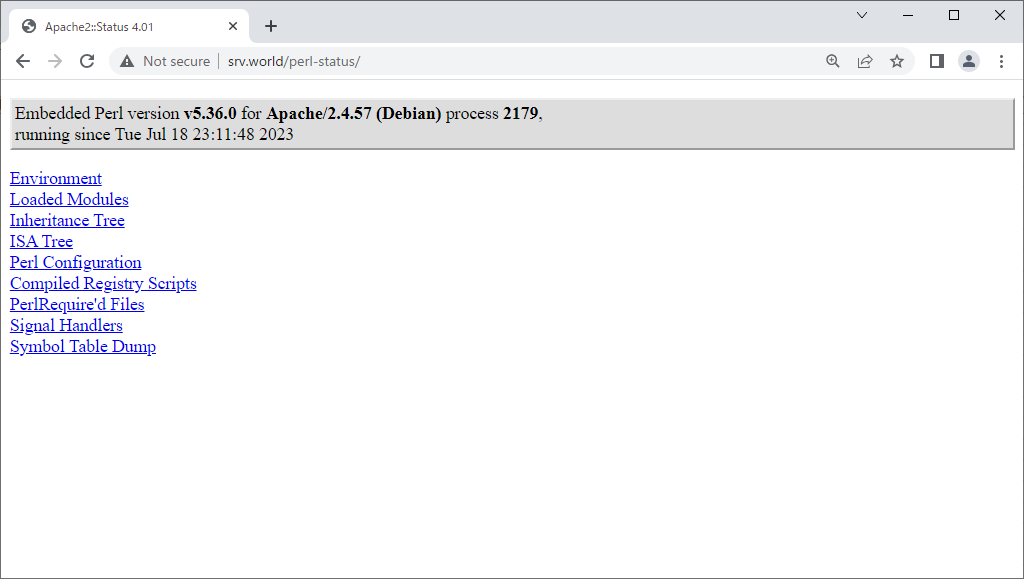
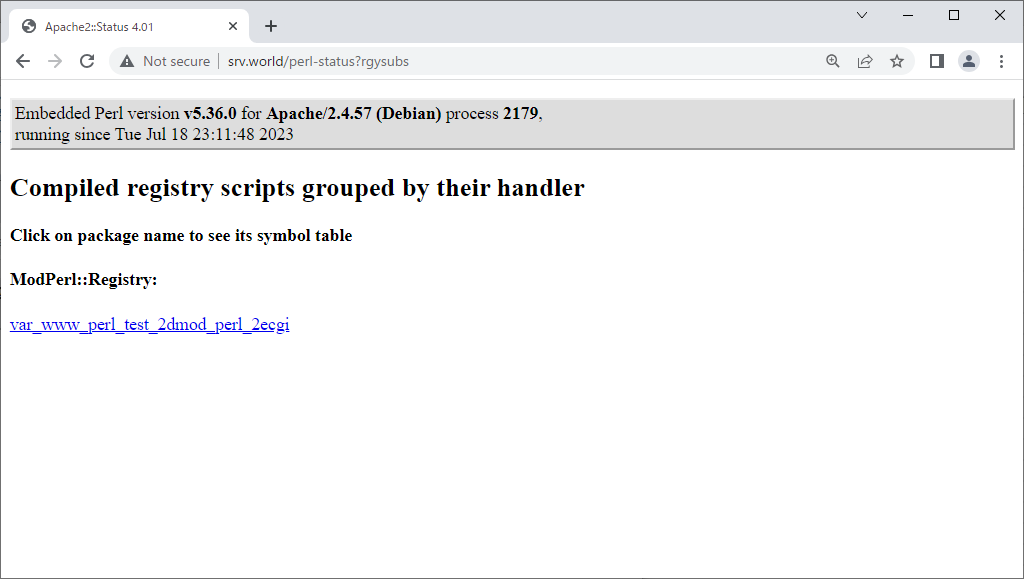
| [6] | By the way, it's possible to see the status of [mod_perl] to access to [(your hostname or IP address)/perl-status]. |
|
|
Matched Content